|
Phone: 778 300 1803 info@powerstripsolar.com |
THE CASE FOR SOLAR DOMESTIC HOT WATER
The classic solar domestic hot water pre-heating appliance is considered a mature technology in Canada yet is has barely scratched the surface of its market potential. This straightforward system can tackle 40% of the home's hot water bill in Canada and every home could have one. That potential has spurred many demonstration programs proving the technology reliable and functional so why aren't they selling? System DescriptionA typical residential solar hot water heater usually consists of 6 sq m of glass covered solar collectors (two 4'x8' solar panels), a storage tank of about 450l (120 gallons), a pump and solar controller and insulated piping. Current plumbing codes in BC require a double walled heat exchanger (dumb rule that needs to be changed) and backflow prevention as well as leak detection all adding to the costs. Water is pre-heated on its way to a hot water tank reducing the work the hot water tank has to do. The NumbersIf we look at solar radiation data for Toronto or Vancouver we find that there is about 28 GJ of solar energy available on a 6 sq m surface facing the sun each year based on typical weather data. In BC solar domestic hot water heaters generally are displacing natural gas and natural gas is cheap! The cost of natural gas after its burned in a hot water tank and converted to hot water is about $10/GJ in Vancouver, therefore, a solar domestic hot water heater that is 6 sq m in collector area can collect $280 worth of energy in natural gas dollars if it collects 100% of the solar radiation that is available. It is impossible to do better because that is all that is available. Actually its not "impossible". If the air is warmer than the water being heated in the collector and the collector is not insulated as in the case of an unglazed swimming pool heating type solar collector the collector can collect the solar radiation plus heat from the air itself for an efficiency greater than 100% but that's not going to happen in the case of the higher temperature collectors typically specified for this application. So what portion of what is available can we expect to collect? You have to remember that in BC there is a lot more solar radiation available in the summer compared to winter and many days the solar tank will be fully heated up and solar will shut off because the high temperature limit is reached. There's no way anyone can expect any solar device to collect 100% of what is available. Typical operating collector efficiencies are no better than 75% over their operating range in this application. Using Retscreen simulations and experience from monitored sites we believe 50% is optimistic. If one of these systems collects and delivers 50% of the solar resource that is available then it saves $140/year against natural gas in BC at today's prices. The following chart and link to NRCan's Buyer's guide for solar hot water systems indicates solar hot water can displace 40% or more of the home's hot water heating cost in Canada. Perhaps some people are confused due to the fact very little money is spent on hot water heating in the home compared to space heating and electricity. On page 15 of that Buyer's Guide you will see the estimate that a typical home uses 740 cubic meters of natural gas per year. At $10/GJ this converts to $280.00 (26.1 cubic meters creates about 1 GJ). If the chart above is correct then approximately 43% of $280 is $120 in savings per year which is right in line with our estimate above ($140/year saved). These numbers are therefore credible. Computer simulations and CSA packaged systems listings indicate the annual energy delivery to be around 8-9GJ/year. At $10/GJ that's a savings of $80-$90/year. These systems sell for $14,000 in an immature market (Canada) down to as little as $5000 after rebates and incentives (of which currently there is very little available). We've seen bulk purchases where the installed cost gets down to $8000 before incentives. If you can buy one for $8000 installed then you can expect a simple payback period of 57 to 100 years based on an expected savings of $80-$140/year. We would expect the price to come down to the $5000 level if the market was stronger. That would get the simple payback down to 36-62 year range. Where natural gas is double the cost as in many regions of BC the payback improves by a factor of 2. In BC electricity is $0.10/kwhr or more and rising. This translates to $28/GJ which is almost 3 times the price of natural gas. Against electricity the simple payback drops considerably and it becomes possible to finance the capital cost with the energy savings. Compared to heat pump savings or in conjunction with a heat pump the numbers for solar stand on their own without any help from government once we get the costs down to a more competitive level. We haven't included any maintenance costs but these are fairly minor. We also have not included any environmental considerations. These are not so minor. |
The Case for Solar Hot WaterWe can't often make the case for residential solar hot water heating based on the energy savings numbers alone. At the low price of natural gas today that should not come as a surprize to anyone. We are mortgaging the future of the planet to allow us to pig out on cheap energy today. Proponents of solar thermal hot water systems for the home should not apologize for the reality of the numbers. The fossil fuel industry and the government should be apologizing for using our atmosphere as a free dumping ground for the carbon and pollutants directly resulting from the burning of fossil fuels. We still haven't included environmental cost in the equation yet. When we do its easy to justify the investment. Its an investment in the future. Its something that actuates this generation's compensation for leaving the environment in worse shape when we leave it to our children than when we were born. Every other energy source we enjoy today was kickstarted and supported with a big investment by government. Why should solar be the only energy solution to have to slug it out on its own in direct competition with subsidized fossil fuel alternatives? Its all backwards. If governments are looking for new energy sources to meet the demands of the future and we all truly do want to recognize global warming as a real issue then how can anyone resist supporting government's efforts to incentivize solar hot water heaters for every home in the country? The Solar Hot Water Marketplace Without Government InvestmentOf course the true numbers will scare most buyers away but that's OK. Most people aren't buying anyway, not without rebates and incentives. This industry would grow considerably if one person in 1000 became a willing customer. Gregor Robertson the mayor of Vancouver has a solar hot water system and his family wakes up to the sound of the solar heater reacting to the availability of solar radiation. His family loves this feeling. His and many other stories are told on Solar BC's web site. The City of Vancouver requires all new home construction to be preplumbed for solar. That alone may be enough to get the price of the typical solar hot water heater down to the level where the payback period can be as little as only one human lifetime. At some point in the future, energy costs will reflect their true value and the solar vision we in this industry all have will become a reality even if the government remains unwilling to support the effort. Meanwhile, solar advocates shoot themselves in the foot by claiming their offerings will pay for themselves in 5 years. Obviously, now that we've published this, it should be clear to anyone that that is just nonsense. This charade has caused a backlash on the part of some industry members (including Hot Sun) with a longer term vision.Realistic Solar Thermal Markets in Canada Without IncentivesWhat is happening is municipalities are deciding to reduce their footprints themselves but municipalities have to justify their tax dollar investments to their constituents. It comes down to what value is placed on the carbon and other pollutants. In BC the carbon tax will cap out at $30/ tonne in 2012. Experts have cited that the carbon tax needs to be $150/tonne to affect any real change. In natural gas dollars $30/tonne represents about $1.50/GJ. Its about 15% of what we currently pay in BC. If we consider the value of the carbon or the environmental cost of the carbon to really be $150/tonne then we can add 75% to the cost of the natural gas. Now we're at a 32 year payback potential for our example residential system of 6 square meters of solar collector and 120 gallons storage at the bargain price of $8000 installed. Before supporting solar domestic hot water for homes, municipalities need to pick their low hanging fruit. Solar must first be applied where huge water heating loads exist. We can do large scale solar hot water systems at better than a 15 year payback period when the loads are huge. Huge loads mean we can do all our work at the low end of the temperature range where unglazed solar collectors are more efficient and far less expensive as in this 2011 installed solar hot water heater pre-heating 16 showers at the Minoru Aquatic Center in Richmond BC. 15 years seems like a long payback but the typical solar thermal investment has been closer to 50 years at best historically and 15 years is a payback where the capital cost can be financed with the energy savings and the end result is an awful lot of carbon reduction at no cost to the taxpayer. Solar DHW Preheater ConclusionsIn conclusion solar dhw can rarely be justified on the numbers in BC even with a significant price tag for carbon. We need to go even further to justify this. We need to look at what governments have done and continue to do to support the natural gas industry. They take all the risk of exploration away. The thinking is that we all need cheap fuel to finance our growing economy. We at Hot Sun aren't exactly sure what the cost of natural gas would be without subsidies but we're sure it would be a lot higher and more importantly it would fluctuate. When the price goes up by a facor of 2 suddenly as oil did in 2008, all of a sudden bean counters everywhere start adding a big risk factor to the expected future price of natural gas that we're comparing solar's life cycle cost to and suddenly the solar phone starts to ring. When you add all these factors together it does justify the decision to solar heat your hot water. It's not a negative carbon footprint. It doesn't use more carbon to make than it produces. There's no case against it and there is every case for it. If federal and provincial governments won't get behind it then leadership needs to come from municipalities. People can take action themselves by purchasing the technology without rebates. It's an investment in the future. We suggest you buy from a company that is not claiming it will pay for itself in 5 years. That company is negligent and ignorance is no excuse in this field. At Hot Sun we know many good solar people across Canada and are happy to provide a reference without a commission or kick back of any sort. The case for solar dhw is that its an easy way to cut the natural gas consumption in a home without having to reduce actual energy use. Its an energy plant right on the rooftop of the home. Its energy that didn't have to be created by burning fossil fuels. Its energy you produced yourself. Its a very attractive and compelling technology. There is no need to pretend that it pays for itself agsinst natural gas. Doing so only dis-credits the industry and slows acceptance. Its easy for Hot Sun to say. We got out of solar dhw in 1990 as soon as we learned the payback wasn't the 3 years we were told by the manufacturer. Anyone selling solar hot water in Western Canada today who isn't "lying about the payback" is a hero and deserves your investment. |
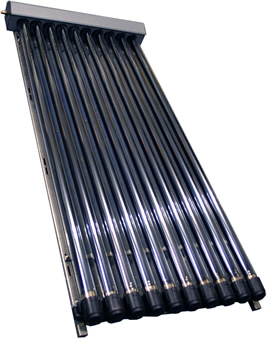
A typical evacuated tube style solar hot water heating solar panel
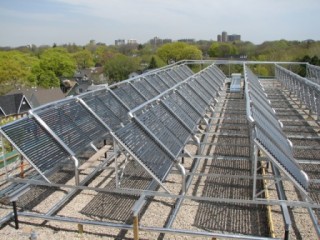
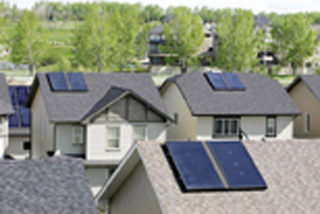
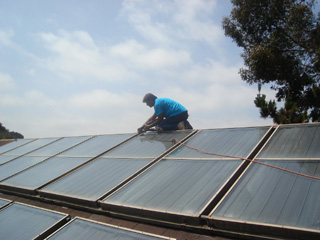
A large scale solar hot water system using low cost low pressure evacuated tubes Solar hot water heaters belong on every rooftop Hot Sun employee Pat Welish works on an old boxed and glazed solar heater Solar Wins is a BC solar dhw company doing good work |